The past 6 months of almost every moment of my free time has been spent developing an algorithm with my friend
Tom Buckley-Houston to exhaustively prove that we’ve found the longest line of sight in the world.
We both felt it was very doable algorithmically, but current options looked extremely computationally intensive.
Since the inception of the project, through hard work and collaboration, we have been able to speed up the calculations
by hundreds of times, and make it entirely feasible on top-of-the-line CPUs such as the AMD Turin.
Please enjoy the deep dive, and make sure to check out Tom’s sister-blogpost
and https://alltheviews.world for the final product!
As it is truly 6 months worth of information, I’ve broken it up into 3 main chunks, with an intermission:
An introduction to the total viewshed and lines of sight algorithm,
which is required reading for the other two.
Data layout and how that affects performance, and the optimizations
we found to make the most of the CPU cache.
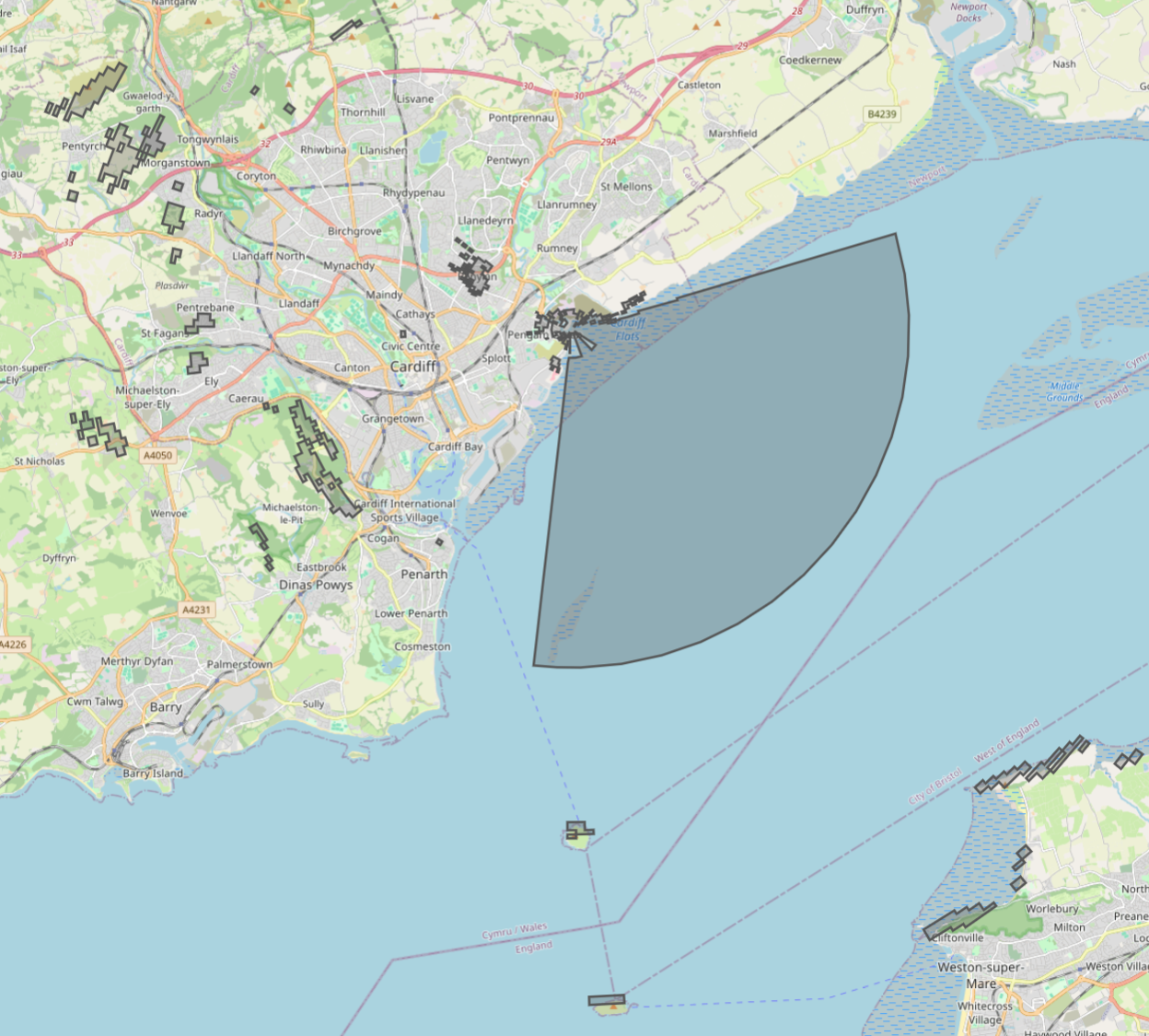
A viewshed is all the area visible from a particular location on the map:
It also happens to hold the longest line of sight, since it is the furthest
visible point from the observer.
Traditional viewshed algorithms take Digital Elevation Mappings (DEMs) and calculate the angles pair-wise for all points
and then determine whether there are obstructions. This approach works well for a single viewshed, however, scaling to
more than one runs head-first into cache issues.
You could imagine if you naively apply this pair-wise computation you end up re-fetching and re-calculating quite a lot.
Tools like ArcGIS do single viewshed calculations on the order of minutes, which works just fine for a single viewshed
but makes every point on the planet algorithmically infeasible, so a new solution was needed. We needed a “total viewshed” algorithm,
not just a single viewshed.
At the foundation of the total (or single) viewshed algorithm lies the humble line of sight visibility calculation.
The line of sight visibility is the measure of visibility for some slice of the viewshed, say one
degree, which accumulated makes up a full viewshed.
Line of sight visibility calculations are entirely boolean (is the point visible to the observer or not) and are entirely
two-dimensional. To make this three-dimensional slice of space two-dimensional, we use an azimuthal projection to
project our observer into a two-dimensional space.
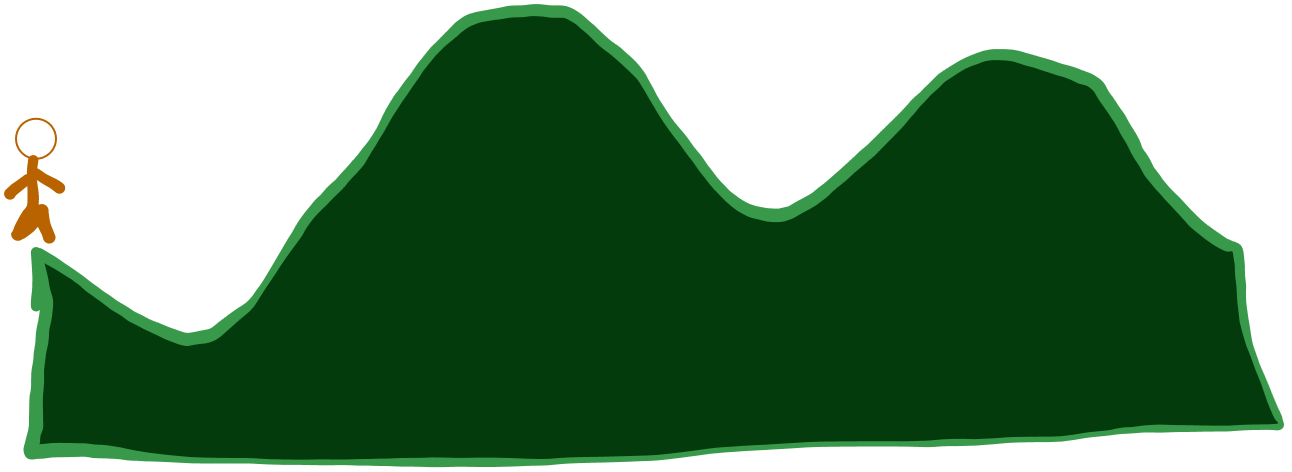
Yes, ‘azimuthal projection’ is just a fancy way of describing the Google Map Guy™’s POV
The elevations “in front of” the observer on the y-axis, distance on the x. The line of sight may lie between
two elevations so an interpolated value is chosen and a “band” of sight is also chosen, meaning the observer sees
exactly one point at a time.
The angle of elevation between two points must also take into account the curvature of the earth,
along with the refraction of light. The equation for adjusting the elevation for both is given by
the following equation:
Where \(E\) is the original elevation, \(D\) is the distance to the point, \(R\) is a refraction coefficient
which has been calculated to be \(\approx.13\), and \(d_{earth}\) is the diameter of the earth in kilometers.
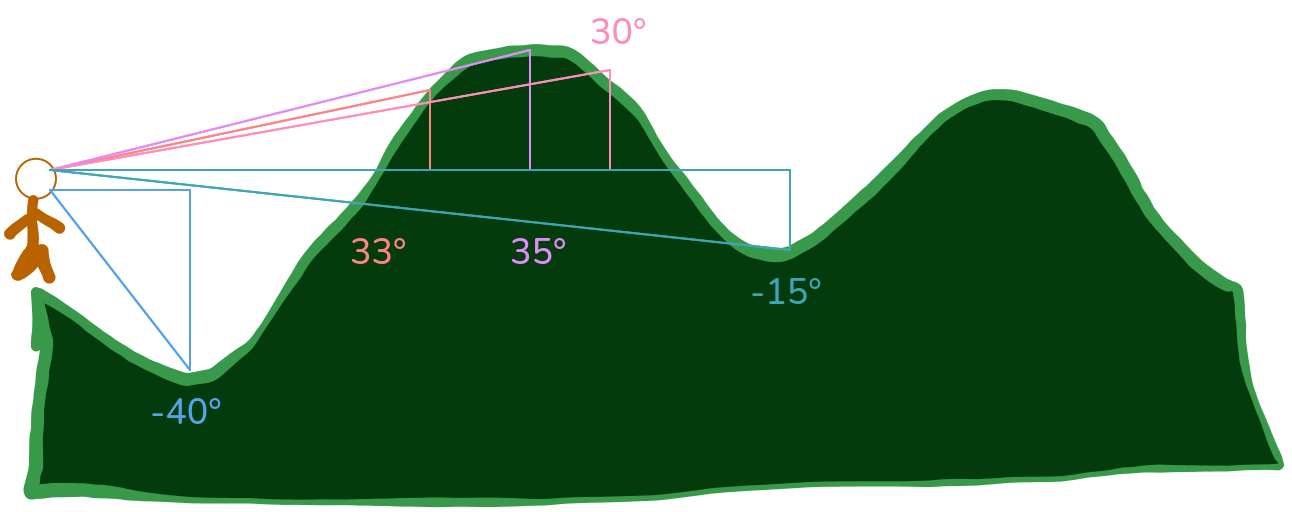
The angle of elevation, \(\theta\), between a point along the line of sight forms a right triangle. Since adjusted elevation is on
the opposite side of the triangle, while the distance to the point is the adjacent side, \(tan\) will be our friend:
$$
tan(\theta) = (E^\prime - h_{pov}) / D \newline
\theta = tan^{-1}((E^\prime - h_{pov}) / D)
$$
Where \(h_{pov}\) is the height of the observer.
Math Nerd (arc)Tangent:
For computational purposes we won’t actually carry out \(tan^{-1}\). We can get away with this because
1) we don’t need the angle for anything other than comparison and 2) \(tan^{-1}\) is continuous and monotonically
increasing on \((-\infty, \infty)\). This means \( tan^{-1}(x_1) > tan^{-1}(x_2) \iff x_1 > x_2 \) so the extra computation
doesn’t give us anything extra.
Once the angles of elevation are laid out, we can determine visibility for each point along the line of sight.
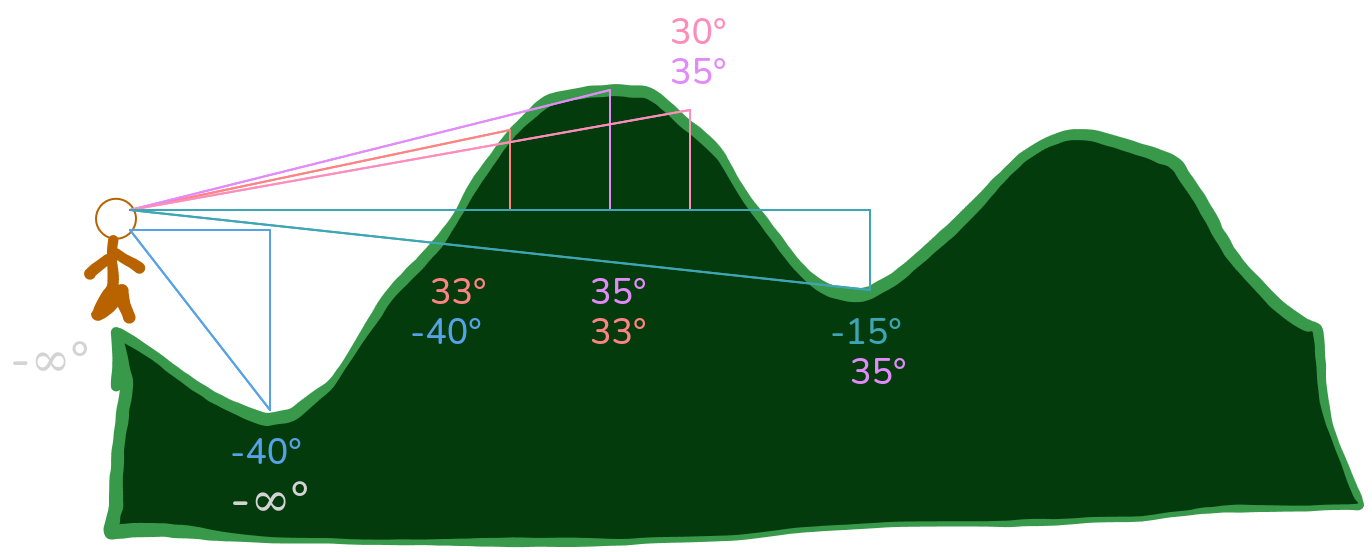
A point is visible to the observer if the angle of elevation between the observer and the point is greater than all
the angles of previous points. The angle between the point of view and itself \(-\infty\) since there is
“no angle” and we want all angles to be greater than it.
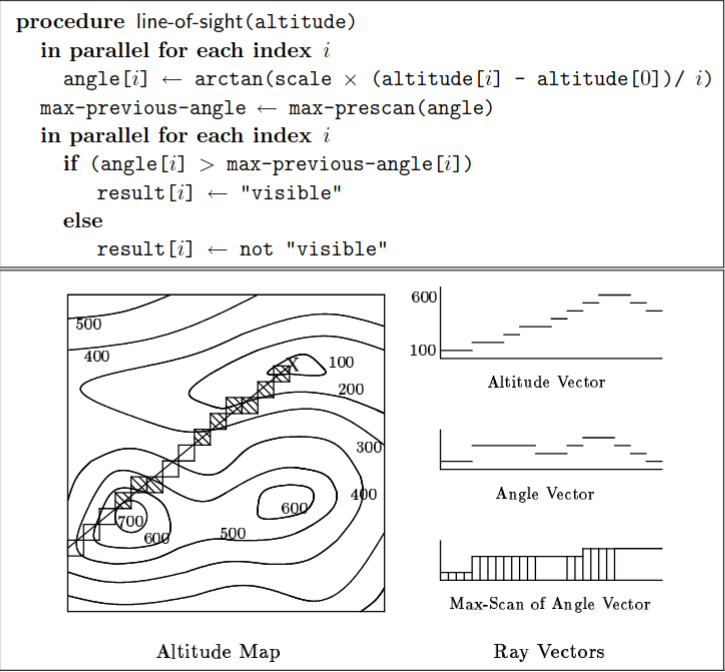
Calculated angles of elevation, along with their respective ‘highest previously seen angle’
Here our observer determines visibility at each point by checking to see if the current angle is greater than
the maximum of all previous angles, which is pictured below the previous graphic’s angle calculation.
Rotating this line of sight calculation around for all the terrain within the worst case line of sight for a given point
will give you 360 different bitmaps of which points are visible. You can use those to construct a viewshed.
Now that we have line of sight visibility down, we can move on to the meat and potatoes, the total viewshed.
There isn’t a ton of literature existing for calculating total viewsheds for large maps. However, there are a few
prolific authors in the total viewshed space who have published many papers. Namely, Tabik et al. My friend Tom
read their initial total viewshed paper back in 2017 while researching
how to find the longest line of sight, which had been a dream of his.
In the paper, they lay out a solution that attempts to parallelize a single viewshed calculation to calculate a total viewshed.
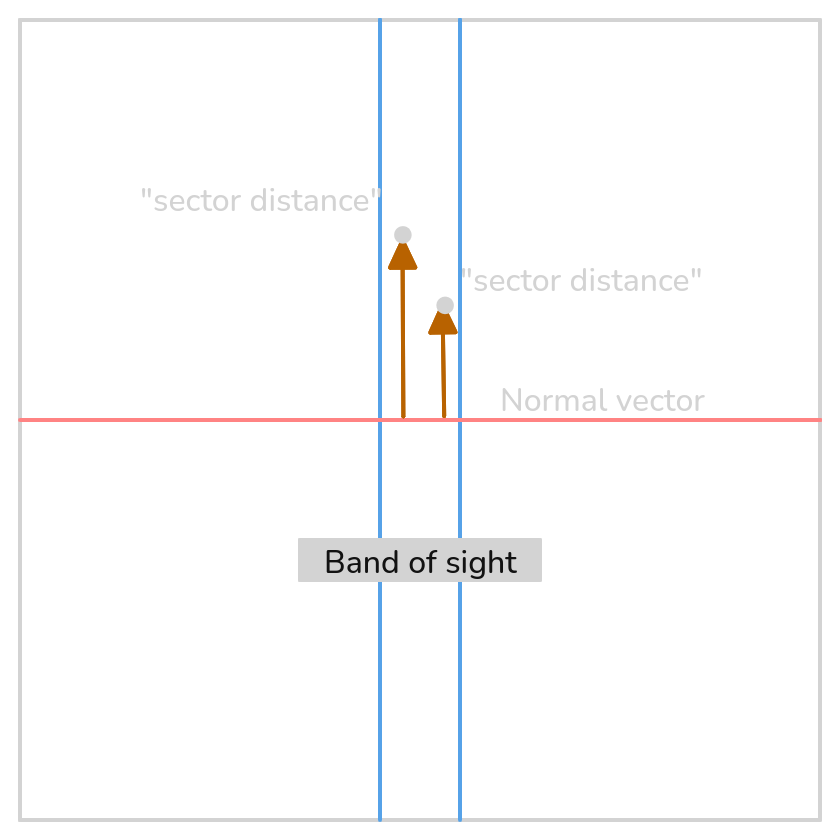
Their approach makes use of Linear Algebra to find the closest points to a normal vector (that they call the sector)
so they can determine which points to sample along the line of sight visibility calculation. In the paper they call
this “sector ordering”.
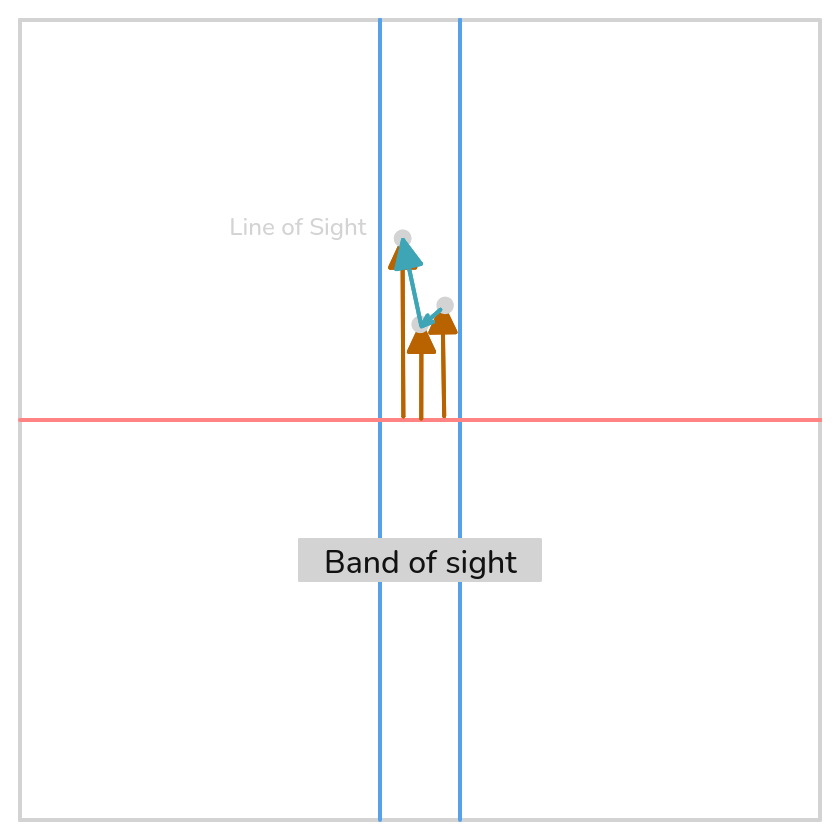
Sector distances are not necessarily uniform from point to point (even potentially zig-zagging) along the line
of sight so they must also be kept track of.
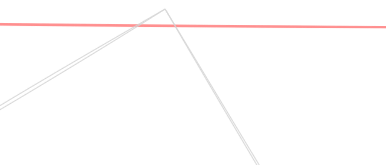
This line of sight zigzags
They construct the line of sight projection using a linked list container like so:
struct node {
    node* prev; // previous elevation in line of sight
    node* next; // next elevation in line of sight
    int16* data; // elevation data
    float distance; // distance from pov
}
The linked list elevation data isn’t a copy of the elevation data, it is a pointer to it.
This then gets shipped off to a GPU for visibility calculation. The linked list and sector distances get reconstructed
for every line of sight for every point and angle duplicating a ton of work.
Very quickly Tom found that the linked list is Not A Good Idea™. In fact, the maximum line of sight is always
going to have some upper bound, so we can pre-allocate an array of that size. Rather than pointers, Tom calculated
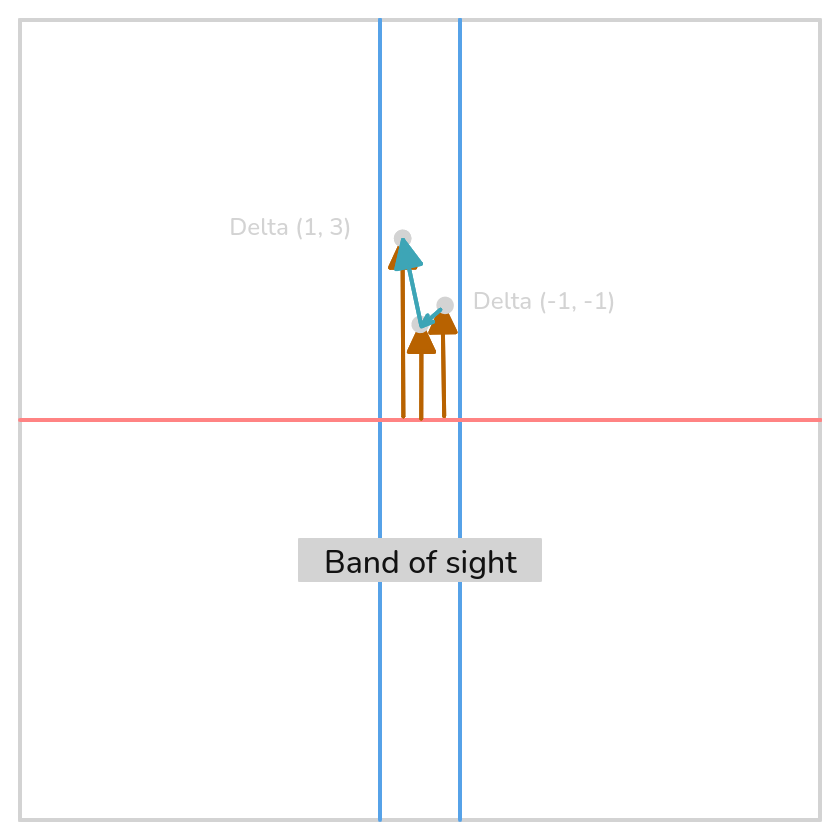
position-independent offsets into the DEM, which he called “deltas”.
Tom also was able to make a parallel array for the sector distance. This way you add your delta to get the elevation,
you use the distance from the sector distance array, and then you are able to calculate the angle to the point along the
line of sight.
Those offsets stay the same for every angle, so Tom only ever had to calculate them once rather for each point like the
other paper.
Deltas are really just vectors you can add to get where you’re going
With deltas, you take your point of view’s index, add the delta, and it gives you the index into the DEM of your
next point along your line of sight. Do this for every point for every angle and you have a total viewshed. No linked
list or pointer indirection involved.
Tom left his improvements on the back burner for 8 years until July 2025 when he started porting it to Rust.
Since Mount Everest is the tallest point in the world, the total viewshed that includes its peak was a very
attracting benchmark for us. We immediately made it our “north star”. You’ll notice throughout the blogpost I
discuss timings of per-angle benchmarks, all of them refer to Everest.
The worst case line of site was estimated to be 670km by Tom, but we wanted it just a tad smaller so we could run faster.
So, we stuck with a nice round 600km. This also happens to be one of the biggest worst case lines of sight in the world,
so if we could get it running fast on Everest, then surely the world would be right around the corner.
Tom’s initial runs showed that running all of Everest took about 12 hours. Our first test runs didn’t show any
lines of sight over 400km, confirming 600km was a safe estimate. Once it came time to do the whole world though,
this wouldn’t do.
For more on why there’s such a gap between the worst case line of sight and the actual longest line of
sight check out this section in Tom’s blogpost.
Tom worried there may be even longer worst case lines of sight, such as 800km. An algorithm that has to check a
DEM which has \(n \times n\) elevations, and also checks a total of \(n\) elevations along your line of sight - for
360 angles - you are looking at potentially taking almost 2.4x longer with a 1.3x longer worst case line of sight.
Tom’s initial estimates were that this would cost us potentially hundreds of thousands of dollars and many months
of spot instance compute (meaning it could be shut down at any time). This was not feasible for either of our time
or money budgets, and I was certain that we could do better and calculate the whole world.
After rubbing some braincells together on the problem and re-implementing the algorithm myself, I noticed a complete lack
of cache locality. Tom’s total viewshed algorithms may not have to recompute the “deltas” for each point, but it
is effectively a single viewshed algorithm applied for every point. Not exactly good for having to compute every viewshed.
The points are not processed in any particular order, meaning that while you are working from
left to right within the DEM, you are likely accessing completely different elevations.
This effectively benchmarks your processor’s prefetcher with the number of cache misses you’ll incur, not the FLOPs.
How bad are these cache misses? Well, the elevation data we have is at a resolution of 100m. For our lower-than-needed
upper bound of 600km for Mount Everest’s we are talking 36 million elevations. Those elevations are stored as i16s
totaling ~72MBs. Much bigger than what L3 can fit.
My mind first went to “sorting by lines of sight”. Deltas take a single point and get us to the next point, but don’t
care about what order you process points in. Since the next point is now in cache, it would be nice to reuse the data
for the next line of sight calculation.
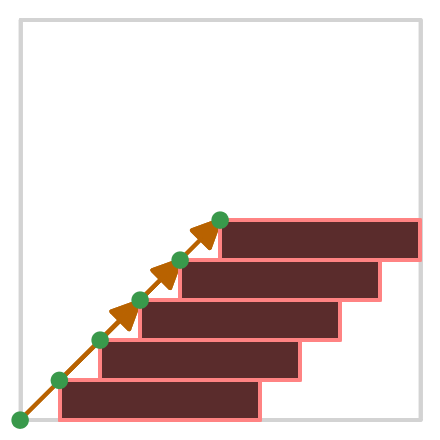
However, this falls flat on its face very quickly for a very simple reason: a line of sight is not contiguous in terms
of memory. By accessing non-contiguous memory you may be loading some of the data into cache, but most of it is
not being used in the line of sight calculation.
All the red bars are the full cache line of points your CPU fetches when asked to load the green points
In fact, in the worst case, since elevation data is stored as an i16 you are wasting 96% of a 64 byte cache line. OUCH.
With that much data being wasted, I set out to try to guarantee all data accesses for all lines of sight were contiguous,
and wouldn’t you have it, all the squinting and rotating my head paid off.
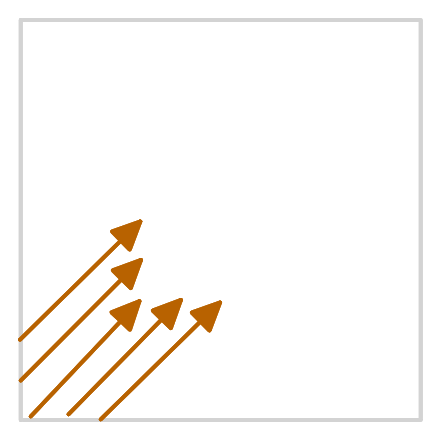
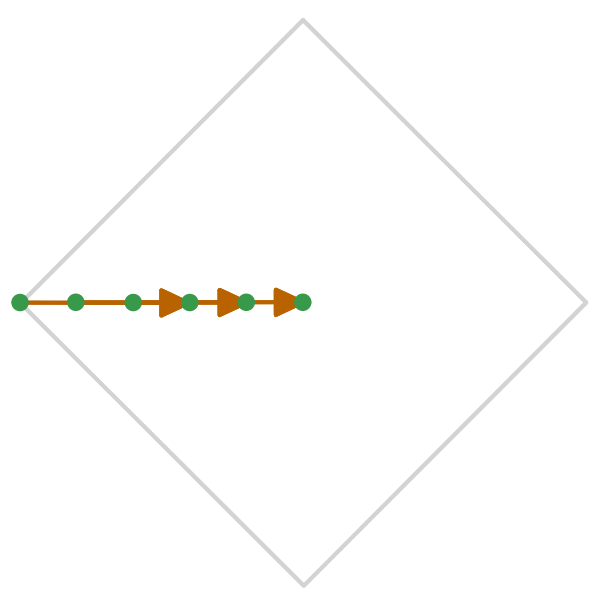
After staring at deltas and their corresponding distances for much too long, the deltas for 45 degrees popped out to me
as particularly interesting. Not only were lines of sight much faster to calculate for 45 degrees, but visualizing the
deltas showed that they create perfectly diagonal lines from the point of view and going across the DEM.
The distances were also entirely uniform between points.
Since these lines are perfectly straight, why couldn’t I make them entirely contiguous in memory and process the lines
of sight from left to right instead of corner to corner?
After the first load, the rest of the green points are in cache!
This looked absolutely too good to be true! Surely rotating the map only works for some points but not all. And maybe
it gets strange at angles that aren’t divisible by 45 and the whole idea is dead in the water? Would the distances
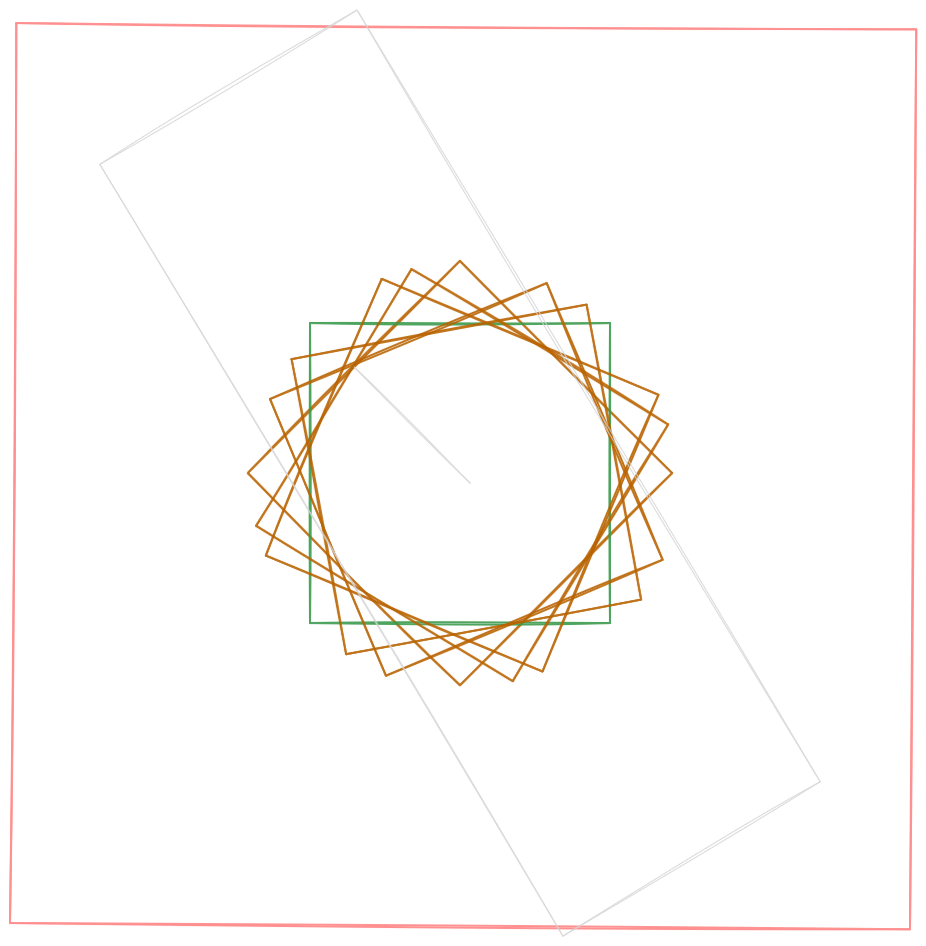
be able to stay continuous? After wondering if this was doable or missing points, Tom and I sat down, convinced ourselves
that this was possible and generated this image:
A circle seen forming in the center of the DEM from all the rotations
Tom had already noticed that the original authors were only calculating lines of sight internally to the DEM.
When it came to calculating the full line of sight for every point they stopped short, mentioning it as a limitation
of the algorithm. This results in very few full viewsheds actually being valid.
However, if you have 3x the data padding the tile, all lines of sight will be able to be calculated for lines
of sight for all angles. While messing with rotations, we realized that only 2 times the data is required for computing
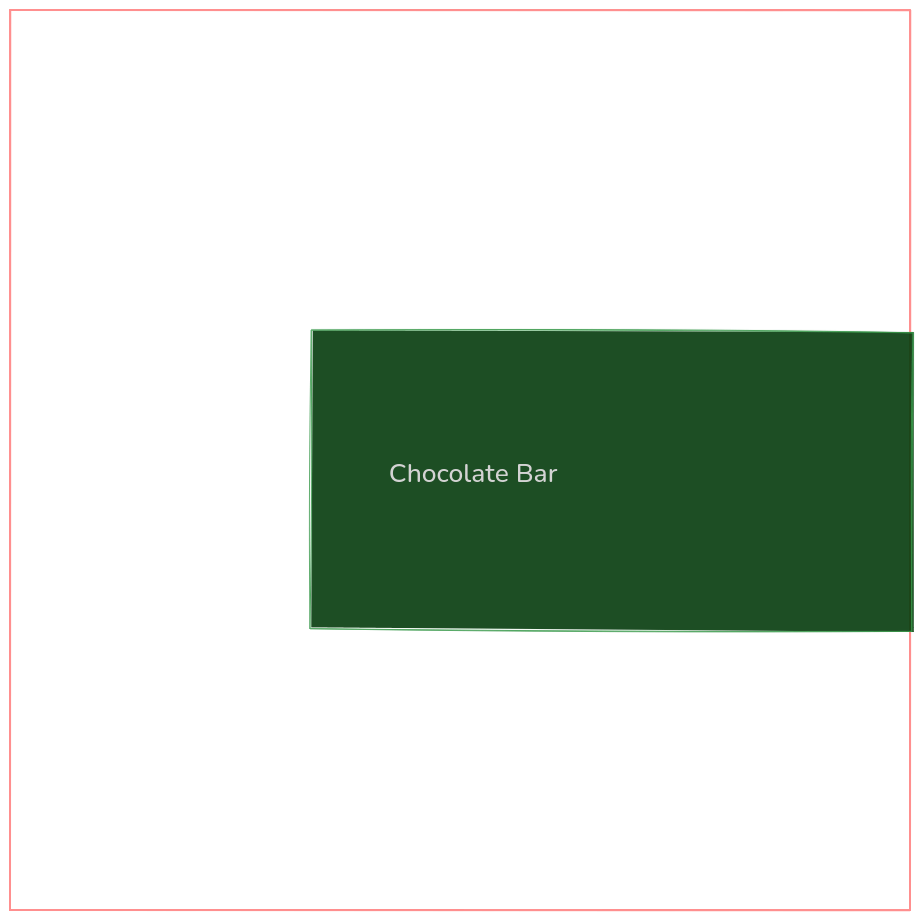
the line of sight per angle. Instead of rotating the entire DEM, we only need to rotate a rectangular portion,
which we nick-named the “chocolate bar”
A chocolate bar in all its glory
The square tiles were now outliving their usefulness. When rotating the rectangle, it sometimes “juts” outside
the DEM, meaning we don’t have the data for it. We nick-named these “dolphins” because they create little triangles
when overlaid with the DEM that look like a dolphin’s top fin.
A dolphin fin
Dolphins occur because squares don’t have infinite rotational symmetry so stuffing a rotated tile back into a square causes
it to be cut off. To fix this, we can just use circular tiles. The total viewshed is still padded with 3x the data,
except it is now 3 times the diameter of the worst-case longest line of sight.
The deltas and sector distances are dead! Viva la Rotación!
Now that we rotate the map, we completely front-load all our cache misses and perfectly align our data for our
line of sight calculations. Of course, this is all unidirectional as we are only calculating every point’s line of sight
at a single angle. Rotation to align all the lines of sight incurs roughly a one-second penalty for even the biggest
DEMs. A huge win.
Cutting down the amount of data ends up meaning that we can fit multiple widths worth of the DEM into L1 for calculation.
Another HUGE win.
There is one downside that bears mentioning: when calculating the rotated coordinates for an elevation it may not fall
between a single elevation evenly. You have to interpolate some elevation there so that a line of sight
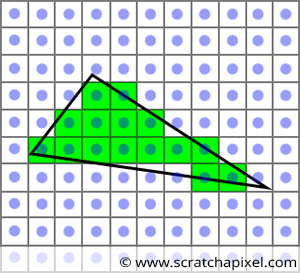
calculation can be performed and not just have missing data. This is called rasterization.
We chose the “nearest neighbor” interpolation algorithm because it is extremely easy to implement and is considered to
be within the acceptable margins of error established in the academic viewshed literature (See Siham Tabik et al. in
Efficient Data Structure and Highly Scalable Algorithm for Total-Viewshed Computationhttps://ieeexplore.ieee.org/document/6837455).
Attempting to make rotation a function mapping coordinates from the unrotated image onto to the rotated one also runs
into trouble. Streaks will be unfilled because it isn’t guaranteed there is a one to one mapping of coordinates when
there is rounding involved. Mathematically, we can see this because rotated points aren’t guaranteed to be unique
due to \(\lfloor(x, y)\rceil\) meaning this function isn’t one to one:
$$
rotate(x, y, \theta):
\begin{bmatrix}
cos \theta & -sin \theta \\
sin \theta & cos \theta
\end{bmatrix}
\begin{bmatrix}
x \\
y
\end{bmatrix}
$$
$$
DEM = \{ 0 \le x < DEM_{width}; 0 \le y < DEM_{width} \mid (x, y) \}
$$
$$
DEM_{rotated} = \{(x, y) \in DEM \mid \lfloor rotate(x, y, \theta) \rceil \}
$$
$$
DEM \cap DEM_{rotated} \neq DEM
$$
This is solved by doing an “anti rotation”. Looping over all the points of the output image, and choosing the closest
coordinate in the input.
$$
anti\_rotate(x, y, \theta): rotate(x, y, -\theta)
$$
$$
DEM_{rotated} = [ 0 \le x < DEM_{width}; 0 \le y < DEM_{width} \mid DEM[\lfloor anti\_rotate(x, y, \theta) \rceil] ]
$$
Now it is guaranteed there’s a point in \(DEM_{rotated}\) for every \((x, y)\) but it isn’t guaranteed to be unique.
This is fine for our purposes.
Once we developed the optimal cache setup to guarantee that our calculations are no longer
memory bound, the world became our oyster. A global total viewshed calculation seemed right on our doorstep.
Initial runs showed that our algorithm ran at about ~120 seconds per angle for Everest. This being with very little optimization,
just straight-line Rust code. This timing means Everest takes 12 hours, but good news, it is single threaded so there’s
plenty more to go.
With the high-level architecture complete we decided to name our algorithm, CacheTVS.
CacheTVS has three different types of outputs:
the surface area heatmap,
the point-by-point longest line of sight,
the viewshed bitmaps
The surface area heatmap is an estimate of the visible area from a point of view.
The point-by-point computation for the line of sight holds the angle and distance of the longest line of sight found.
The viewshed bitmaps are the boolean visibility computations out to the worst case line of sight for all 360 degrees.
We mainly only use the first two, as we calculated that storing the viewshed bitmap for Everest would be a few Terabytes
worth of information, and it doesn’t actually give us anything extra. The world would be many Petabytes. We really only need a
visualization of how much area each point can see, and of course the longest line of sight.
Also, we personally don’t have hard drives big enough :(
In total, we use exactly 8 times the amount of data of a single DEM which is entirely feasible and only around
200GB for the entire world.
As mentioned previously, all our initial tests were single threaded. Since the total viewshed calculation works
on an angle by angle snapshot of the data, we can already parallelize this by the number of cores what we have,
which for my machine is 8 cores. Because this workload is compute heavy, it doesn’t make sense to make use of SMT
since threads will be fighting heavily for compute units.
To get the new total benchmark time for 8-way parallelism, we just divide the amount of work, 360 angles, by the
amount of cores and multiply by the number of seconds each takes.
With the easy parallelization out of the way, it is time to see if we can squeeze extra parallelism out of our processor.
There are many ways in which a CPU is parallel, not just multi-threading. You also have instruction-level
parallelism along with SIMD.
Initially, lets focus on the first. Speaking of, what does our line of sight calculation currently look like?
fnline_of_sight(pov_height: i16, refraction: f32, elevations: &[i16]) -> (f32, f32) { // (surface area, distance)
letmut highest_angle =-f32::INFINITY;
letmut longest_distance =0.0f32;
letmut surface_area =0.0f32;
for (distance, elevation) in elevations.enumerate() {
// calculate the curve and refraction adjustment
let curve_and_refraction = ((distance.powi(2) asf32) * (1- refraction)) /EARTH_DIAMETER;
let elevation_prime = (elevation asf32) + curve_and_refraction
// calculate the "angle" (really a ratio, not arctan)
let angle = (elevation_prime - (pov_height asf32)) / distance
// as we determined in the beginning, if the angle is higher,
// then the point along our elevation map is visible.
//
// Add its area to the surface area, and update the longest
// distance we've seen, and set it as the new highest angle
if angle > highest_angle { // <- depends on the previous iteration
longest_distance = distance asf32 highest_angle = angle
// TAN_ONE_RADIAN comes from the original paper. I'm not
// sure that it is correct, but it makes for a decent estimate
surface_area += distance *TAN_ONE_RADIAN }
}
(surface_area, longest_distance)
}
The main performance issues of this loop arise because each iteration depends on the previous iteration.
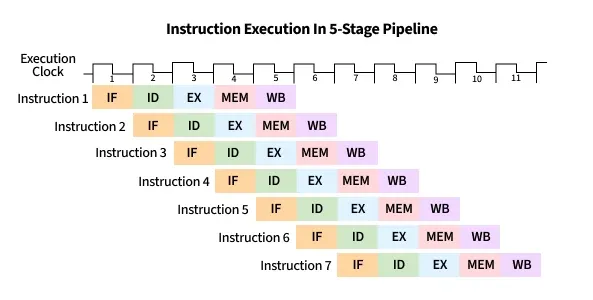
CPUs work best when the next instruction doesn’t depend on the result of any previous instruction. CPUs use
instruction pipelining to issue multiple instructions, allowing instructions to work in parallel so long as there
are no inter-instruction dependencies. This is called Instruction Level Parallelism (ILP).
A 5-stage CPU pipeline courtesy of GeekForGeeks
In the case of the line of sight, the computation that is truly independent of any iteration is
the angle computation. It is only based on distance and elevation, not any angle before or after.
To be able to unshackle it from the loop-carry dependency, we will trade off storing and re-loading it from
memory for extra ILP. Thankfully this all still fits in L1 so the ILP benefits far outweigh the memory cost.
We can rewrite the loop as follows:
fnline_of_sight(pov_height: i16, refraction: f32, elevations: &[i16], angle_buf: &mut [f32]) -> (f32, f32) { // (surface area, distance)
assert_eq(elevations.len(), angle_buf.len())
for (angle, (distance, elevation)) in zip(angle_buf.iter_mut(), elevations.enumerate()) {
// calculate the curve and refraction adjustment
let curve_and_refraction = ((distance.powi(2) asf32) * (1- refraction)) /EARTH_DIAMETER;
let elevation_prime = (elevation asf32) + curve_and_refraction
*angle = (elevation_prime - (pov_height asf32)) / distance
}
letmut highest_angle =-f32::INFINITY;
letmut longest_distance =0.0f32;
letmut surface_area =0.0f32;
for angle in angles {
// as we determined in the beginning, if the angle is higher,
// then the point along our elevation map is visible.
//
// Add its area to the surface area, and update the longest
// distance we've seen, and set it as the new highest angle
if angle > highest_angle { // <- depends on the previous iteration
longest_distance = distance asf32 highest_angle = angle
// TAN_ONE_RADIAN comes from the original paper. I'm not
// sure that it is correct, but it makes for a decent estimate
surface_area += distance *TAN_ONE_RADIAN }
}
(surface_area, longest_distance)
}
We’ve now maximized the ILP of the angle calculation, but the longest line of sight calculation and
surface area calculation still aren’t particularly parallel. Let’s fix that!
A prefix sum is a computation that takes a list of numbers and maps it to another list
where each new element is the cumulative sum of all elements before it, hence its name.
Here’s a sample implementation:
Abstractly, a prefix sum is part of a general family of algorithms called an “inclusive scan”. A scan is an even more general
algorithm that takes a sequence, an associative binary operator, and applies the binary operator to an accumulated value
and yields the newly accumulated value. Rust has this in its standard library with .iter().scan()
let nums =&[1, 2, 3, 4, 5];
// yields the same as above
let prefix_sum = nums
.iter()
.scan(0, |acc, elem| {
*acc += elem;
Some(*acc)
})
.collect()
Why do we care about scans? Well, for the real numbers max also happens to be an associative binary operator.
When we do our visibility calculations, we are comparing the current angle against the highest angle:
If we have a prefix maximum of all the previous angles, then we could independently calculate
whether a particular point is visible by checking to see if angle > prefix_max.
Fortunately for us, max also happens to be associative for the floating point values that we compute. Generally speaking,
floating point values are not associative due to NaNs and signed zero. We never do any computation that
could yield either result, meaning we are safe to use max associatively.
Interestingly, I’m not the first person to think about the application of a prefix maximum for
line of sight visibility calculations. While researching the parallel prefix max, I stumbled upon this interesting
paper written all the way back in 1993. The author mentions line of
sight visibility calculations as an off-hand example of how a prefix scan can enable parallelism:
Great minds think alike, I guess
Scans have two variants, inclusive and exclusive. Careful readers may have realized we aren’t comparing the
highest angle to the prefix maximum which includes itself (like the above prefix sum). Instead, we are comparing
the angle to the maximum of all previous angles (exclusive of itself). For this reason, we use an exclusive
prefix maximum.
If we allocate a second buffer and stuff the exclusive prefix maximum in there, our loop iterations
calculating the total surface area become entirely independent of one another. Calculating the longest
line of sight also falls out of our surface area calculation.
Here’s the updated algorithm. I’ve broken it out into three separate functions as we now calculate the line of sight in
three discrete steps:
Angles
Prefix maximum
Visibility (surface area and longest line of sight)
Before parallelizing further, I noticed that our angle calculations redo the same curvature computation over and over.
When you have potentially hundreds of millions of lines of sight to process, that’s quite a bit of extra computation. We haven’t hit an issue
with cache pressure yet so let’s pre-compute the curve and refraction adjustment, and also pre-compute the distances between points.
Tiles generally are all of the same scale, 100m, but we add it in for future use:
// generate the curvature adjustments given the scale, refraction and worst case line of sight, `max_los`.
fngenerate_distances(max_los: usize, refraction: f32, scale: f32) -> (Vec<f32>, Vec<f32>) {
let adjusted_refraction = refraction -1.0;
(1..=max_los)
.map(|step| {
let distance = (step asf32) * scale;
let adjustment = (distance * distance * adjusted_refraction) /EARTH_DIAMETER;
(distance, adjustment)
})
.unzip()
}
We now can run this once and keep it out of our angle calculation loop. Nice!
We’ve almost squeezed every little bit of ILP out of our algorithm, so now is the time to talk about
another type of parallelism. SIMD.
SIMD stands for “Single Instruction Multiple Data”. SIMD widens registers by multiple times the width
of data, say 8 f32s, and allows a single instruction to be issued to do computation on all elements at once.
Because of the parallel nature of our computation, we are a good fit for rewriting the algorithm to use SIMD. Instead of calculating
a single angle at a time, we can calculate 8 at a time on my x86 machine - which has AVX2 - and as we’ll see later, up to 16 at a time on
AVX-512 machines.
Rust currently has an unstable nightly feature called “portable SIMD” which lets us abstract over the hardware architecture,
which will work well for our most basic computations.
Trivially, we can use portable SIMD to widen both our angle and longest line of sight computations. Check it out:
// requires #![feature(portable_simd)]
use std::simd::prelude::SimdFloat as _;
use std::simd::{LaneCount, Simd, SupportedLaneCount};
// fancy itertools macro that lets us zip multiple iterators into one big unnested tuple
use itertools::izip;
fncalculate_angles<constVECTOR_WIDTH: usize>(
pov_height: f32,
angles_out: &mut [f32],
elevations, distances, adjustments)
where LaneCount<VECTOR_WIDTH> : SupportedLaneCount{
assert(elevations.len().is_multiple_of(VECTOR_WIDTH));
// turn a &[f32] into a &[[f32; VECTOR_WIDTH]]. The r.h.s of the assignment
// is the portion that doesn't fit into VECTOR_WIDTH, but we can ignore it since
// the length of the slice is asserted to be a multiple of VECTOR_WIDTH
let (vector_angles, _) = angles_out.as_chunks_mut::<{ VECTOR_WIDTH }>();
let (vector_elevations, _) = elevations.as_chunks::<{ VECTOR_WIDTH }>();
let (vector_adjustments, _) = adjustments.as_chunks::<{ VECTOR_WIDTH }>();
let (vector_distances, _) = distances.as_chunks::<{ VECTOR_WIDTH }>();
for (angle_out, &elevation, &distance, &adjustment) inizip!(
vector_angles.iter_mut(),
vector_elevations.iter(),
vector_distances.iter(),
vector_adjustments.iter()
) {
let elevation_f32: Simd<f32, { VECTOR_WIDTH }>= Simd::from(elevation).cast();
let elevation_prime = elevation_f32 + Simd::from_array(adjustment);
let res = (elevation_prime - Simd::splat(pov_height)) / Simd::from_array(distance);
res.copy_to_slice(angle_out);
}
}
fnvisibility<constVECTOR_WIDTH: usize>(angles: &[f32], prefix_max: &[f32], distances: &[f32]) -> (f32, f32)
where LaneCount<VECTOR_WIDTH> : SupportedLaneCount{
assert(angles.len().is_multiple_of(VECTOR_WIDTH));
let (vector_angles, _) = angles.as_chunks::<{ VECTOR_WIDTH }>();
let (vector_prefix, _) = prefix_max.as_chunks::<{ VECTOR_WIDTH }>();
let (vector_distances, _) = distances.as_chunks::<{ VECTOR_WIDTH }>();
let (simd_area, simd_longest_distance) = izip(angles, distances, prefix_max)
.fold((Simd::splat(0.0f32), Simd::splat(0.0f32)), |((acc_area, acc_distances), (angle, distance, prefix_max)) {
let mask = angle.simd_gt(prefix_max);
// if we don't have _any_ elements, then why carry out the rest of the computation?
if!mask.any() {
return (acc_area, acc_distances);
}
let selected_distances = mask.select(distance, Simd::splat(0.0f32));
let surface_area = selected_distances * Simd::splat(TAN_ONE_RADIAN);
(acc_area + surface_area, acc_distances.simd_max(selected_distances))
}| }
(simd_area.reduce_sum(), simd_longest_distance.reduce_max())
}
Programming with SIMD is a very different way of thinking because as you may notice, there are no conditionals.
Instead, each element is compared pairwise with each other to create a “mask”. Then, you use
that mask to “select” which elements you want to use for true (our distances) and which to use
for false (zero).
Rust has some very interesting codegen for the !mask.any() that I haven’t fully grokked, so I’ll leave it for a second blog
post. Suffice it to say that it still uses all vector instructions, and is able to shave 10% off of our time.
If no points within the 8-wide vector are visible (which is very common), there’s no reason to do any other calculation,
so there’s at least some intuition as to why it is faster.
Rust strives to be a safe language, so all float computations are done without the fastmath flags. Enabling the fastmath
flags in Rust is annoying, and also not recommended for various other reasons.
One reason why you might want to turn on fastmath flags is that at least on x86, some instructions such as
comparisons and floating point maximums end up generating a lot of extra instructions to comply with IEEE floating point
standards because guess what: Intel’s instructions don’t.
For this project, we actually don’t care a ton about the IEEE standard for comparison or maximum as we aren’t
generating any NaNs or signed zero. For x86 we implement max with the _mm_max_ps intrinsic and implement greater than with _mm_gt_ps. No extra instructions.
This gets more important in our next section because we are going to make use of the max instruction quite a bit,
and we need to make sure the minimal number of instructions are generated. It’s all to help us stop avoiding the SIMD
elephant in the room: the prefix maximum calculation.
Calculating the prefix maximum with multiple threads would induce a huge amount of overhead for a small amount
of work, so instead we want to parallelize our prefix maximum via SIMD. The level of parallelism we get out of
the algorithm will be from clearing up the instruction pipeliner and keeping the carried dependencies minimal.
Because max is associative, we can calculate the prefix maximum for all the angles that fit within a
single SIMD register, keeping all calculations independent of one another to make ILP go brrr.
Then we loop back over the data to propagate the maximum of each through the data. A common pattern you may be
picking up on.
That all is very abstract, so here’s a concrete example:
Let’s say we have the following angles in two 4-wide registers.
[1, -1, 2, -2], [3, -3, 4, -4]
We can calculate the prefix max of the first register by shifting in an identity element - in our case -f32::INFINITY;
since max(x, -f32::INFINITY;) = x - and applying our binary operator max. Then we take the result of that and shift in
two identity elements to finish calculating the prefix max in-place:
Now, we can take the maximum from the first register, which is always the last element, and splat it across a whole SIMD
register, then call max with it and the second register to complete the process:
max([3, 3, 4, 4],
    [2, 2, 2, 2])
= [3, 3, 4, 4]
No change here. But as you can see, associativity is what lets us do this prefix maximum calculation in-place
and lets us only do \(log_2(4) = 2\) calls to max. When we use 8 or 16 wide registers it is still \(log_2\),
so only a modest increase of one or two extra shifts. It also saves us from having to compute something
like max(max(max(1, -1), 2), -2) which contains a computational dependency.
When it comes to accumulating the max from previous vectors to the next ones, we just keep an accumulated maximum
that we apply to each vector, completing the full scan and cementing our prefix maximum of all elements:
letmut local_acc = Simd::splat(highest);
for prefix in vector_prefix {
let cur_prefix: f32x4= Simd::from(*prefix);
// get the highest form the current vector
let cur_max: f32x4= Simd::splat(cur_prefix[3]);
// apply the accumulator to the current vector and store it back
_mm_maxps(local_acc, cur_prefix).copy_to_slice(prefix);
// make sure the accumulator holds the result of max(cur_prefix[3], local_acc)
local_acc = _mm_maxps(local_acc, cur_max);
}
There’s lots more details and not enough space, so if you are interested in the nitty-gritty, you can take a look at
the implementation
. Also take a look at this website or this paper
which were great guides for SIMD and AVX prefix scans.
Now that we are able to calculate the longest line of sight for a given point, we need to do this for every point on
the map. Since we also only go in a single direction, we need to run that for every angle.
As cores finish up doing their single angle heatmap and line of sight calculation, we simply accumulate their results
into a single “final map”. At the end, the map accumulates data for all 360 degrees and we’re done! We have a total viewshed!
It should be noted that there are a good number of cores that get wasted when running with a core count
that doesn’t evenly divide 360. Cores idling waiting for the next angle which doesn’t come. This matters for runs
bigger than a single tile - but we leave this as future work.
After implementing all of the above optimizations and absolutely squeezing the rock as hard as I could,
water did in fact come out. We took Everest’s computation from 120 seconds an angle, down to:
DRUM ROLL PLEASE
75 seconds per angle.
Astounding. This brought us down to 57 minutes for all of Everest on my 8 core machine.
Every little bit of optimization and tuning brought us here, and it was because of the hard work
we put in that we were getting very close to something usable for a world run. There was one last thing that was
holding me back: AVX-512.
Very, very recently, AMD released its Turin line of processor which has full AVX-512F support. Which means rather
than having AVX-512 be two AVX2 calculations in a trench-coat, it is a first-class citizen. Renting a top of the line AMD
Turin and our use of const generics and portable SIMD implementation let us seamlessly turn on support for a
16-wide angle calculation, prefix max, and longest line of sight calculation. Enabling it halved the time per angle,
cutting down the calculation to an average of 35 seconds per angle.
Using the Turins also unlocked a huge number of extra cores. I found that 48 cores was the sweet spot for our algorithm.
Now instead of taking an hour, with 48 cores and AVX512, we were taking just over 4 minutes for all of Everest. ALL OF EVEREST.
This is a 160x speedup over Tom’s GPU algorithm.
As I was writing this we were able to get access to an even more powerful AMD Turin. With 96 cores
it saw no slowdowns past 48 cores, and a 10% performance increase per-angle, taking the total time of Everest’s total
viewshed down to 2 minutes. Future runs will be using these.
Now that we were confident that we had the quickest algorithm we could think up, it was time to run the longest line
of sight algorithm for every tile in the whole world. Tom calculated
the worst case line of sight and chunked up the globe, which ended up chunking into about 2500 tiles ranging
from 50 kilometers across to a whopping 800 kilometers.
Since our algorithm is \(O(n^3)\) where \(n\) is the worst case line of sight, small tiles will run in much quicker than
4 minutes, while larger tiles will take much longer than 4 minutes. About 50% of the tiles are under 450km, whereas
50% of the total area of all tiles comes in at 1900 tiles and under 650km.
To process all the tiles, we took a stab at a Tom-and-Ryan version of a MapReduce
cluster with 5 AMD Turin machines. We called it Atlas, and you can read about it here.
All in all, the full world run took 18 hours and cost us a few hundred dollars which is much less than the
few hundred thousand that Tom initially estimated.
Looking for the longest line of sight? Go check it out at https://alltheviews.world and see
our curated list of the top ten longest lines of sight. You won’t believe number 3!
Don’t forget to go play with the interactive map at https://map.alltheviews.world. Click
to find the longest line of sight for any point on earth, and zoom to even find the longest line of sight for your country or state!
If you would like to take a look at all the code this blog post is about, or have any ideas for improvements, here is the
GitHub link for our total viewshed algorithm, CacheTVS.
I’d like to acknowledge Tom for being the rock for which all this research was able to take place on top of.
I’d also like to acknowledge my family and friends for listening to my insane ramblings. They really didn’t know
much that was going on until it all came together, and they got to play around with the tool. Thanks for your patience!